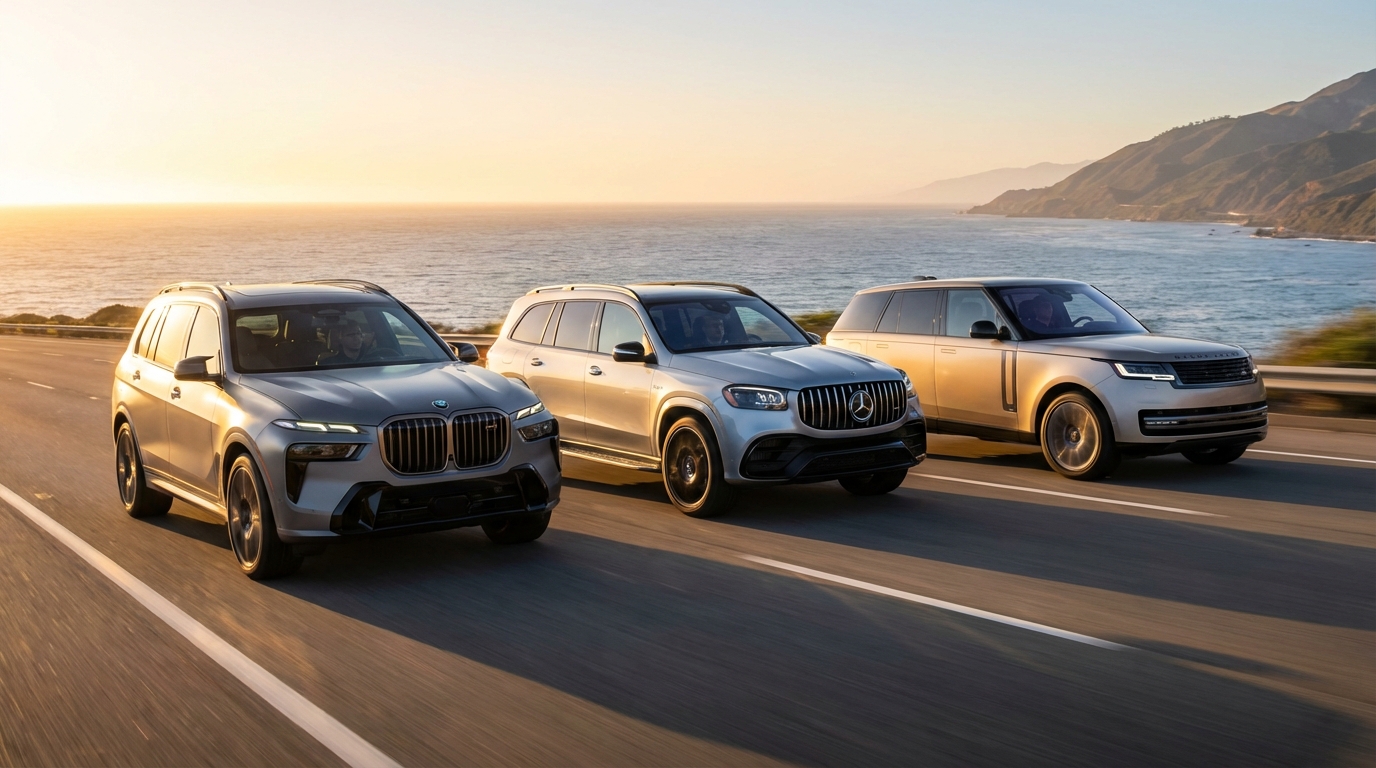
Introduction: Defining the Super-SUV Segment
The luxury three-row SUV segment used to be about compromise. You could have space and comfort, or you could have performance and agility. Rarely could you have both in equal measure. Today, however, titans like BMW, Mercedes-Benz, and Audi are engaged in an arms race to build the ultimate do-it-all machine. Standing tall in this arena is the BMW X7 M60i.
It is not merely a large family bus; it wears the coveted ‘M’ badge, signaling that the engineers in Munich haven’t forgotten about the driver. But how does this Bavarian behemoth stack up in a crowded field of six-figure luxury liners? In this comparison, we pit the X7 M60i against its fiercest rivals to see if it truly balances executive luxury with sports car soul.
The Heart of the Matter: Powertrain and Performance
The defining characteristic of the X7 M60i is its engine. BMW has endowed it with their remarkable S68 4.4-liter twin-turbocharged V8, aided by a 48-volt mild-hybrid system. Producing over 500 horsepower, it launches this massive vehicle with startling ferocity. Crucially, the inclusion of rear-axle steering and active roll stabilization means it handles corners with a flatness that defies physics.
The Rivals
- Mercedes-Benz GLS 580: The arch-rival from Stuttgart offers similar V8 power but tunes its suspension more towards wafting comfort than corner-carving precision. It is softer, quieter, but less engaging when the road gets twisty.
- Audi SQ7: The SQ7 is perhaps the closest in spirit to the BMW. It is incredibly agile and fast, but its interior tech feels slightly a generation behind the BMW’s latest curved display.
- Range Rover: The undisputed king of curbside appeal and off-road prowess. However, to match the M60i’s on-road performance, you have to spend significantly more, and it still doesn’t match the BMW’s sharp driving dynamics.
Interior Luxury and Technology
Inside, the X7 M60i is a showcase of BMW’s latest philosophy. The centerpiece is the massive curved display running iDrive 8 (or the newer 8.5). It is visually stunning, though it relies heavily on touch controls versus physical buttons.
The material quality is exceptional. From the Merino leather upholstery to the crafted glass controls, it feels every bit its price tag. Compared to the glitzy, almost nightclub-like atmosphere of the Mercedes GLS, the X7 feels more architectural and driver-focused. It strikes a balance between the minimalist Audi and the maximalist Mercedes.
Practicality: The Third-Row Reality
If you are buying a three-row SUV, the back seats matter. The X7 offers a usable third row, best suited for children or teenagers, though adults can survive shorter trips back there. It features its own climate controls and sunroof, ensuring those passengers don’t feel like second-class citizens.
However, if absolute maximum space is the priority, American rivals like the Cadillac Escalade or Lincoln Navigator still hold the crown for sheer volume behind the second row. The X7 M60i trades some of that cavernous utility for a smaller footprint that is much easier to park and maneuver in urban environments.
Conclusion: The Driver’s Choice
The luxury three-row SUV market is full of incredible machines, each with a different focus. The Mercedes GLS is the ultimate comfort cruiser; the Range Rover is the style icon. Yet, the BMW X7 M60i carves out a unique niche.
It is the undisputed choice for the enthusiast driver who *needs* six or seven seats but *wants* a performance car. It manages to shrink around the driver when pushed, delivering genuine thrills, before settling back into a comfortable, high-tech family hauler. If you refuse to sacrifice driving dynamics on the altar of practicality, the X7 M60i is hard to beat.